Piezo buzzer
A Piezo Buzzer Driver IC is a specialized power-management component designed to drive piezoelectric ceramic transducers for audible signaling and alarms. Unlike audio drivers optimized for high-fidelity reproduction, buzzer drivers are engineered for maximum Sound Pressure Level (SPL) and power efficiency at specific resonant frequencies.
Technical Architecture
Buzzer driver ICs focus on voltage-swing maximization and low quiescent current to support long-term reliability in battery-powered systems:
-
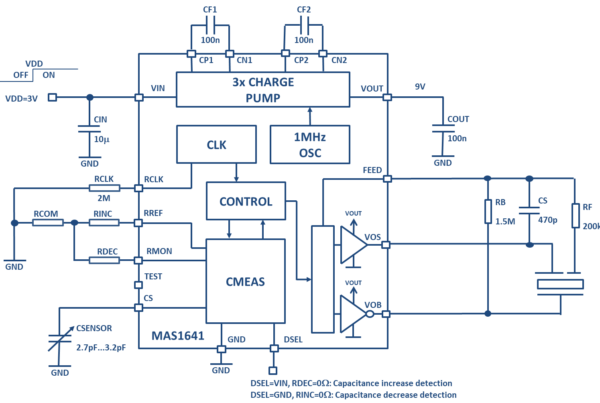
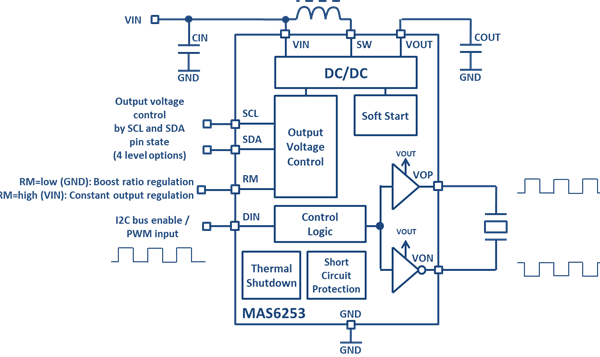
Inductive or Charge-Pump Boost: Steps up low logic-level voltages (e.g., 1.8V–5V) to higher drive voltages (up to 30V+), as SPL is directly proportional to the peak-to-peak voltage ($V_{pp}$).
-
Bridge-Tied Load (BTL) Output: Employs two out-of-phase signals to drive the buzzer, effectively doubling the voltage across the transducer compared to a single-ended drive.
-
Automatic Resonance Tracking: Advanced ICs monitor the back-EMF or current phase to automatically adjust the output frequency, ensuring the buzzer stays at its peak efficiency point despite temperature or mounting shifts.
-
Signal Shaping: Integrated logic to generate square waves (for maximum volume) or sine waves (to reduce high-frequency EMI).
Engineering Advantages
-
High SPL/Current Ratio: Capable of producing >90dB at 10cm while drawing significantly less current than electromagnetic buzzers.
-
Low Profile: Piezo elements are extremely thin ($<1$mm), allowing for integration into slim industrial housings and handheld devices.
-
Zero Magnetic Interference: Ideal for use near sensitive sensors (like Hall effect sensors or compasses) where electromagnetic coils would cause interference.
-
Wide Operating Voltage: Robust input stages allow for direct operation from varying battery chemistries (Li-ion, Alkaline, or Coin Cell).
Critical Application Areas
| Application | Driver Requirement |
| Smoke & Gas Detectors | High-reliability, high-voltage burst for emergency SPL levels. |
| Industrial Instrumentation | Wide temperature stability and high-frequency signaling. |
| Medical Devices | Precise tone control for patient monitoring and fault alerts. |
| Consumer Appliances | Low-cost, high-efficiency feedback for user interfaces. |