Capacitive sensor IC
A Capacitive Sensor Integrated Circuit (IC) is a high-precision device designed to detect changes in electrical capacitance to measure proximity, position, liquid levels, or material composition. By converting physical displacement or dielectric changes into a calibrated electrical signal, these ICs provide a non-contact, wear-free solution for demanding engineering environments.
Technical Architecture
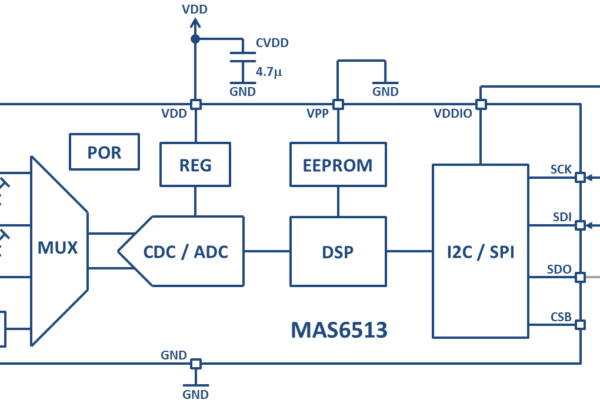
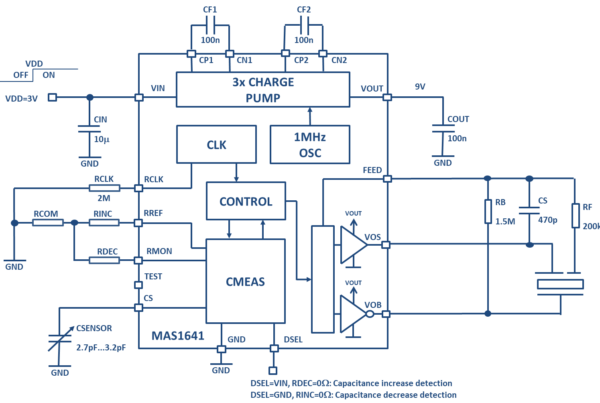
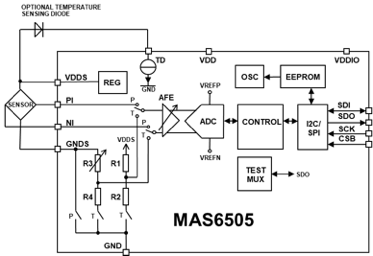
Unlike discrete capacitive circuits, a dedicated IC integrates several critical stages to ensure signal integrity:
-
Excitation Source: Generates a high-frequency AC signal to drive the sensing electrode.
-
Sensing Front-End: Detects minute charges or impedance changes.
-
Active Shielding: Integrated circuitry that drives a secondary conductor at the same potential as the sensor to eliminate parasitic capacitance and EMI interference.
-
Signal Processing: On-chip filtering and linearization to compensate for environmental noise and humidity.
Key Performance Advantages
-
Non-Contact Measurement: Eliminates mechanical wear and tear, significantly increasing the Mean Time Between Failures (MTBF).
-
High Resolution: Capable of sub-micron displacement detection and sensing through non-conductive overlays (glass, plastic).
-
Low Power Consumption: Ideal for battery-operated IoT nodes and mobile hardware.
-
Material Versatility: Detects both conductive materials (metals) and non-conductive materials (liquids, wood, or polymers) by measuring dielectric shifts.
Engineering Applications
Capacitive Sensor ICs are utilized where reliability and sensitivity are non-negotiable:
| Application Category | Implementation |
| Human-Machine Interface (HMI) | Touch-on-metal, proximity wake-up features, and liquid-tolerant touchscreens. |
| Industrial Automation | Liquid level sensing through tank walls and thickness gauging for manufacturing. |
| Automotive | Hands-off detection (HOD) for steering wheels and smart trunk openers. |
| Environmental Sensing | Relative humidity (RH) sensors where the dielectric of a polymer film changes with moisture. |